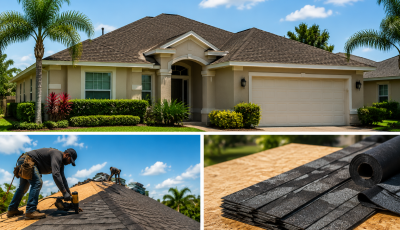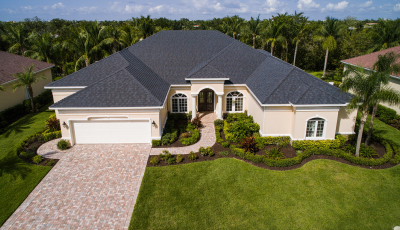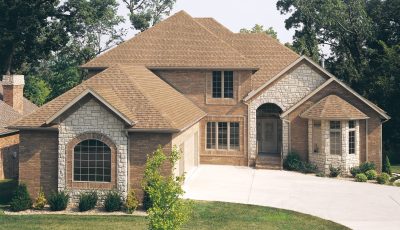
Flat roofs show up more often than many property owners expect over garages, home additions, lanais, and modern-style homes across west-central Florida. They are also commonly used on warehouses, manufacturing facilities, retail buildings, and other commercial properties because low-slope systems can cover large roof areas efficiently. They’re practical and cost-effective when installed correctly, but they also wear differently than a traditional shingled roof, which means flat roof replacement cost gets calculated a little differently too.
If you’re staring at a quote and not sure whether it’s fair, or you’re just trying to plan ahead before your flat roof section starts showing its age, this guide walks through what actually drives flat roof replacement cost, how the material options compare, and what to expect from a properly done job in Hernando County, Pasco County, and Citrus County.
Why Flat Roofs Need a Different Approach
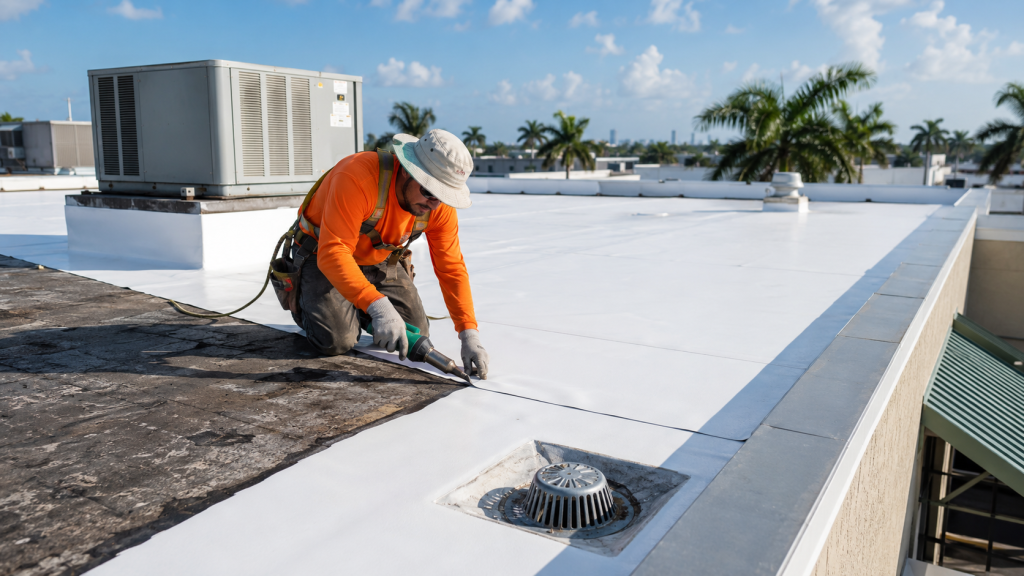
A flat roof isn’t truly flat it has a slight slope, usually under 10 degrees, designed to move water toward drains or scuppers instead of letting gravity pull it straight off a steep pitch. Because there’s less slope working in your favor, the roofing membrane itself has to do more of the waterproofing work. That’s why flat roofs use single-ply membranes or multi-layer systems instead of shingles.
It also means installation quality matters more here than almost anywhere else on your home. A seam that isn’t properly welded or an area with poor drainage can lead to ponding water and slow leaks that go unnoticed for months. Getting the flat roof replacement cost question right starts with understanding that you’re paying for a waterproofing system, not just a covering.
Commercial and Industrial Flat Roof Applications
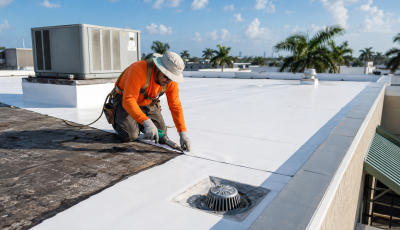
Flat roofing is common on warehouses, manufacturing facilities, retail centers, offices, and other commercial and industrial buildings. A low-slope membrane system can cover a broad footprint while allowing space for HVAC equipment, vents, exhaust systems, and other rooftop components.
Commercial flat roof replacement cost depends on more than membrane price. A contractor should assess the roof deck, insulation, drainage, attachment method, equipment curbs, access, foot-traffic patterns, and how the work may affect building operations. Reflective TPO is often considered for Florida facilities because it can reduce roof-surface heat, while EPDM or modified bitumen may suit other service conditions. The right system for an industrial flat roof replacement depends on the building’s use and exposure as well as cost per square foot.
Flat Roof Replacement Cost by Material
Here’s what homeowners, commercial property managers, and industrial facility owners in our service area may see:
TPO (Thermoplastic Polyolefin)
TPO has become the go-to choice for Florida flat roofs, and for good reason. Its white, reflective surface helps bounce back heat rather than absorb it a real advantage during Florida summers, and one that can noticeably ease your cooling bills. For warehouses and other large commercial or industrial buildings, the reflective surface can also reduce roof-surface temperatures and support cooling-efficiency goals when paired with suitable insulation. TPO typically runs $5 to $10 per square foot installed, with membrane thickness (45-mil, 60-mil, or 80-mil) affecting where you land in that range. For a 1,500-square-foot flat roof section, that puts total cost around $7,500 to $13,500.
EPDM (Rubber Roofing)
EPDM has been used for decades and has a strong track record for durability, often lasting 25 to 30 years with proper maintenance. It generally costs $5 to $9 per square foot installed, making it slightly more budget-friendly than TPO upfront. The trade-off is that EPDM’s black surface absorbs heat rather than reflecting it, which can mean higher cooling costs over time something worth factoring into your decision, not just the sticker price.
Modified Bitumen
Modified bitumen is a multi-layer, asphalt-based system that holds up well under foot traffic, which makes it a common choice for roofs that also serve as a walkable deck or patio surface. It typically runs $4 to $8 per square foot installed and offers a 15- to 20-year lifespan shorter than TPO or EPDM, but a solid option when budget is the primary concern.
As with any roofing project, these are planning ranges, not quotes. The only way to know your actual new roof cost is a proper inspection of your specific roof.
What Drives Your Final Flat Roof Replacement Cost
1. Roof Size and Access
Smaller flat roof section like those over a garage or addition carry a higher cost per square foot than larger commercial-scale roofs because setup and mobilization costs get spread across less area. Warehouses and industrial buildings may benefit from scale, but their total project cost can still be substantial and may increase when cranes, safety controls, or phased access are required. Roofs that are hard to access due to height or limited workspace also add labor time.
2. Insulation and Tear-Off
If your existing flat roof needs to be removed rather than recovered, that adds $1 to $3 per square foot. Adding or upgrading insulation which can improve energy efficiency significantly adds further cost but often pays for itself over time through lower utility bills.
3. Drainage and Ponding Water
If your current roof has areas where water sits for more than 24 to 48 hours after rain, that’s a sign of a drainage problem, not just a membrane issue. Addressing slope and drainage during replacement costs more upfront but prevents the same problem from recurring on your new roof.
4. Penetrations and Roof Features
Vents, HVAC units, skylights, and roof-to-wall transitions all require careful flashing work. Commercial and industrial roofs often have additional rooftop units, exhaust fans, pipes, and equipment curbs, so detailing and coordination can have a larger effect on replacement cost. A roof with several of these features will cost more than a simple, open rectangle of the same square footage.
A Real-World Example
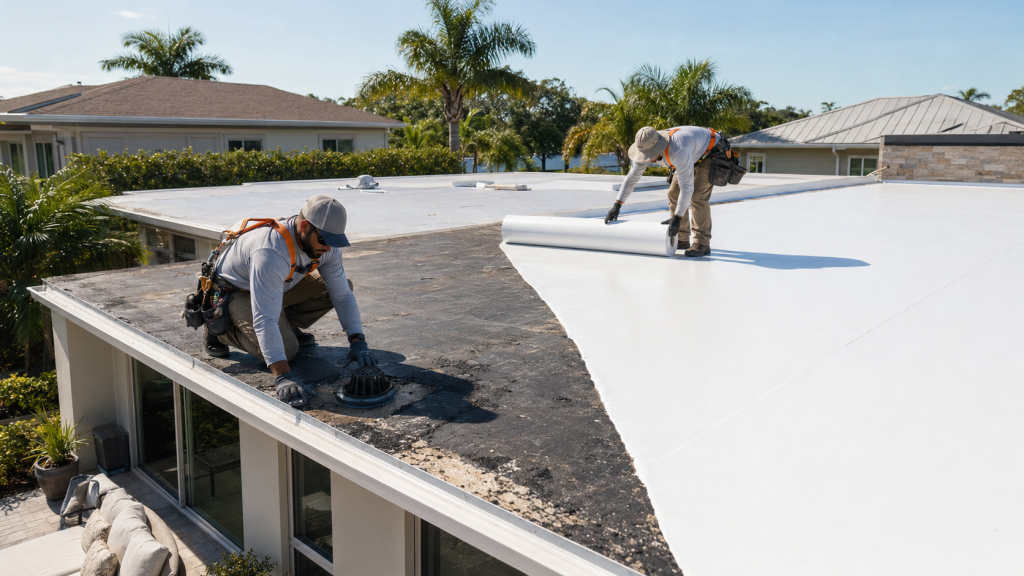
We recently replaced the flat roof section over a home addition in Hudson for a homeowner who’d been dealing with a slow leak near an HVAC curb for over a year. The original modified bitumen roof, installed nearly 18 years earlier, had multiple patch repairs that were no longer holding. During our inspection, we identified two areas of ponding water caused by settling in the original decking something a simple re-cover wouldn’t have fixed. We replaced the decking in those sections, corrected the slope with tapered insulation, and installed a 60-mil TPO membrane. The homeowner’s flat roof replacement cost landed in the mid-range for the material, but the corrected drainage means the same ponding issue shouldn’t return.
That’s the difference between a quote that just covers the roof and one that actually solves the underlying problem.
Flat Roof vs. Metal: Is It Worth Comparing?
Some homeowners ask whether metal roof pricing makes more sense than a traditional flat roof membrane, especially for additions or sections that could be reconfigured with a slight pitch. Metal roofing generally costs more upfront often $8 to $20 per square foot depending on the system but offers a longer lifespan and strong wind resistance. For a true flat or very low-slope section, though, metal isn’t always practical, since it performs best with at least some pitch to shed water. In most cases, TPO or EPDM remains the more appropriate and cost-effective choice for genuinely flat sections, while metal makes more sense for adjoining sloped areas of the same home.
When to Repair vs. Replace a Flat Roof
- Repair is often the right call if damage is localized, your roof is under 15 years old, and there’s no widespread ponding or membrane deterioration.
- Replacement typically makes more sense once repair costs start adding up over multiple years, your roof has reached 75% or more of its expected lifespan, or you’re seeing ponding water in more than one area.
A contractor who’s upfront about which category your roof falls into even when that means recommending a repair instead of a full job is a good sign you’re dealing with someone trustworthy.
Getting an Accurate Estimate
Before you sign anything, make sure your written estimate includes:
- Membrane type and thickness (45-mil, 60-mil, or 80-mil for TPO; EPDM ply count; or modified bitumen layers)
- Insulation type and R-value
- Tear-off and disposal of the old system, if applicable
- Flashing details for all penetrations and roof edges
- Drainage corrections, if ponding water is present
- Warranty terms, both material and workmanship
A quote that’s noticeably lower than others often mean one of these items has been left out and that’s usually where problems show up a few years down the line.
Final Thoughts
Flat roof replacement cost in Hernando, Pasco, and Citrus County generally falls between $4 and $10 per square foot depending on material, with TPO and EPDM being common choices for Florida’s climate. For homes, commercial properties, and industrial buildings alike, the right decision comes down to budget, building use, roof access, insulation, rooftop equipment, and whether drainage issues need to be corrected along the way.
If you’re dealing with a leak, ponding water, or an aging flat roof and want a straightforward, itemized estimate, JK Johns Roofing & Sheet Metal serves property owners across Hernando, Pasco, and Citrus County with on-site inspections and honest recommendations whether that means a repair, a full replacement, or simply peace of mind that the current roof still has some life left in it.
Frequently Asked Questions
How much does flat roof replacement typically cost?
Most homeowners in our area pay between $4 and $10 per square foot installed, depending on material. TPO and EPDM are the most common choices, with modified bitumen offering a lower-cost alternative with a shorter lifespan.
Which flat roofing material lasts the longest?
EPDM and TPO both typically last 20 to 30 years with proper maintenance. Modified bitumen has a shorter expected lifespan of 15 to 20 years but costs less upfront.
Why does my flat roof have standing water after it rains?
Some minor ponding that drains within 24 to 48 hours is normal. Water that sits longer usually points to a slope or drainage issue that should be addressed during replacement rather than repeatedly patched.
Is TPO or EPDM better for Florida homes?
TPO’s reflective white surface helps reduce cooling costs in Florida’s heat, making it the more popular choice. EPDM remains a solid, durable option, particularly for shaded roof sections where heat absorption is less of a concern.
Can I repair my flat roof instead of replacing it?
Often, yes — if damage is limited to one area and the roof hasn’t reached the end of its expected lifespan. A proper inspection is the only reliable way to know whether repair or replacement makes more financial sense.
Are flat roofing systems suitable for commercial and industrial buildings?
Yes. TPO, EPDM, and modified bitumen systems are commonly used on low-slope commercial and industrial roofs. The appropriate system depends on roof size, deck condition, insulation, drainage, rooftop equipment, foot traffic, local weather, and the operational needs of the facility.
Do flat roofs cost more than sloped roofs?
Not necessarily. Flat roof replacement cost per square foot is often comparable to or lower than asphalt shingle roofing, though the total depends heavily on insulation needs, drainage corrections, and roof size.